
What an EC reading can—and cannot—tell a buyer
Electrical conductivity describes the conductivity of the solution being measured. For cocopeat purchasing, the result belongs to a particular prepared extract and test procedure—not simply to the product name. It does not identify every individual ion, establish buffering status or guarantee crop performance.
Use EC as one part of a written specification. Agree limits and methods with the relevant grower, agronomist or laboratory for the intended use. Do not apply one supplier’s number to a different method without checking comparability.
Ask for the extraction method first
Request the named method or laboratory procedure, the sample-to-water ratio and whether that ratio is by mass or volume. Ask about sample preparation, extraction time and water used. Keep a raw-material sample test separate from measurements of fertilised growing media or drainage during cultivation.
For example, CANNA describes a 1:1.5 extraction procedure for assessing coco in a growing context and distinguishes it from drain-water measurements. That is a method example, not an endorsement of a universal acceptance limit for imported raw cocopeat.
Check the units before reading the number
EC may be written in mS/cm or µS/cm. One mS/cm equals 1,000 µS/cm: for example, 0.6 mS/cm and 600 µS/cm express the same conductivity value. This is a units conversion only—it does not make different extraction procedures comparable.
If a report says only “EC 0.6,” ask for the missing unit. If it reports TDS or “ppm,” ask how that value was obtained and which conversion factor was used; do not silently treat it as EC in mS/cm.
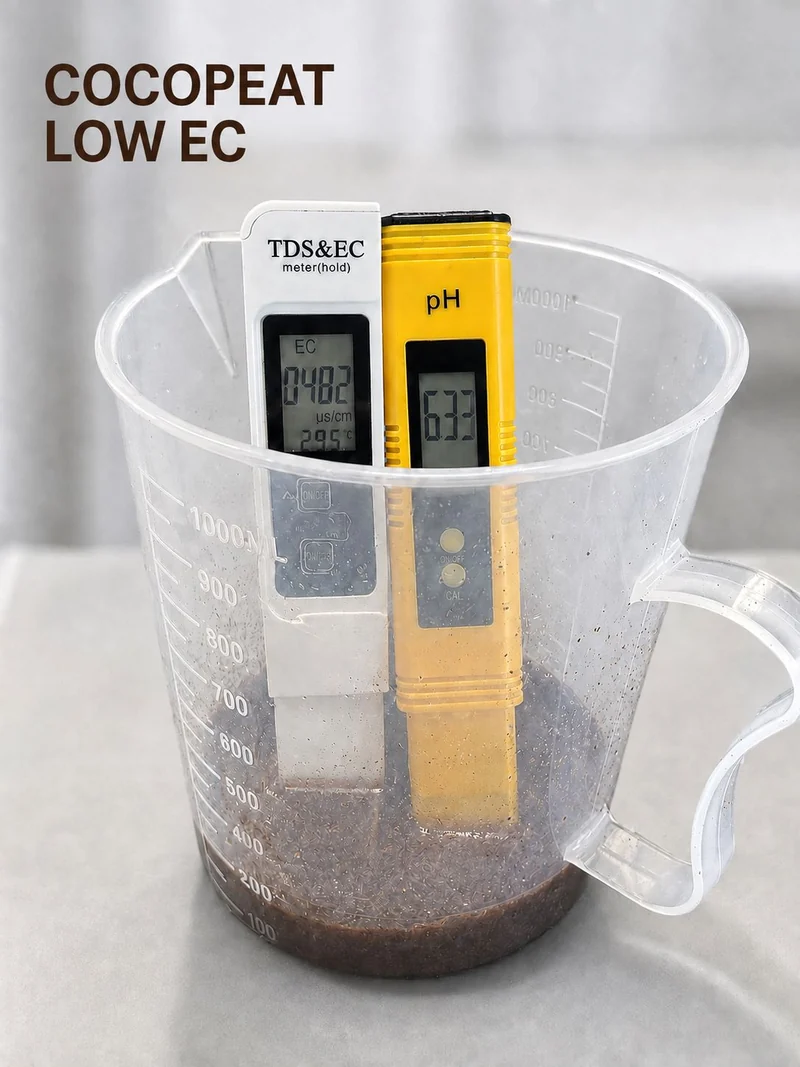
A report checklist to send your supplier
- Product, sample or batch reference and sampling date.
- Laboratory or testing party and report date.
- Method reference, extraction ratio and preparation procedure.
- Water type and relevant water-quality information.
- EC result and unit, measurement temperature or temperature-compensation information.
- Instrument calibration information and pH result where required.
- Acceptance criteria and any individual-ion analysis required by the buyer.
If information is missing, request clarification rather than treating an incomplete report as a pass or fail. Keep the original report with the quotation and sample reference.
Do not confuse low EC with treatment evidence
Washing, buffering and EC testing answer different questions. Ask for the treatment description as well as the measured result. A low reading does not prove that a material has undergone a particular buffering process. See washed versus buffered cocopeat for the buying implications.
Turn the agreed method into an order requirement
Before ordering, write the agreed test method, units, acceptance limits and sample-identification requirements into the specification. Confirm which documentation will accompany the order and how discrepancies will be resolved before shipment.
Agritropic’s published cocopeat block specifications are indicative; final requirements and batch evidence are confirmed with the buyer. COA and sample testing form part of the pre-shipment checks. A COA should be read with its actual scope and sample identity, not as a blanket product guarantee.
Next steps: use the sample evaluation checklist, then prepare a clear sourcing brief.
Ready to prepare your sourcing brief?
Share your product, required specification, quantity and destination so we can discuss the next step.
Request a quote →